
Driveways near Lake Michigan have to handle more than vehicle traffic. In Waukegan and North Chicago, clay-heavy soils, winter freezing, spring thawing, and changing moisture levels can all contribute to pavement movement and cracking.
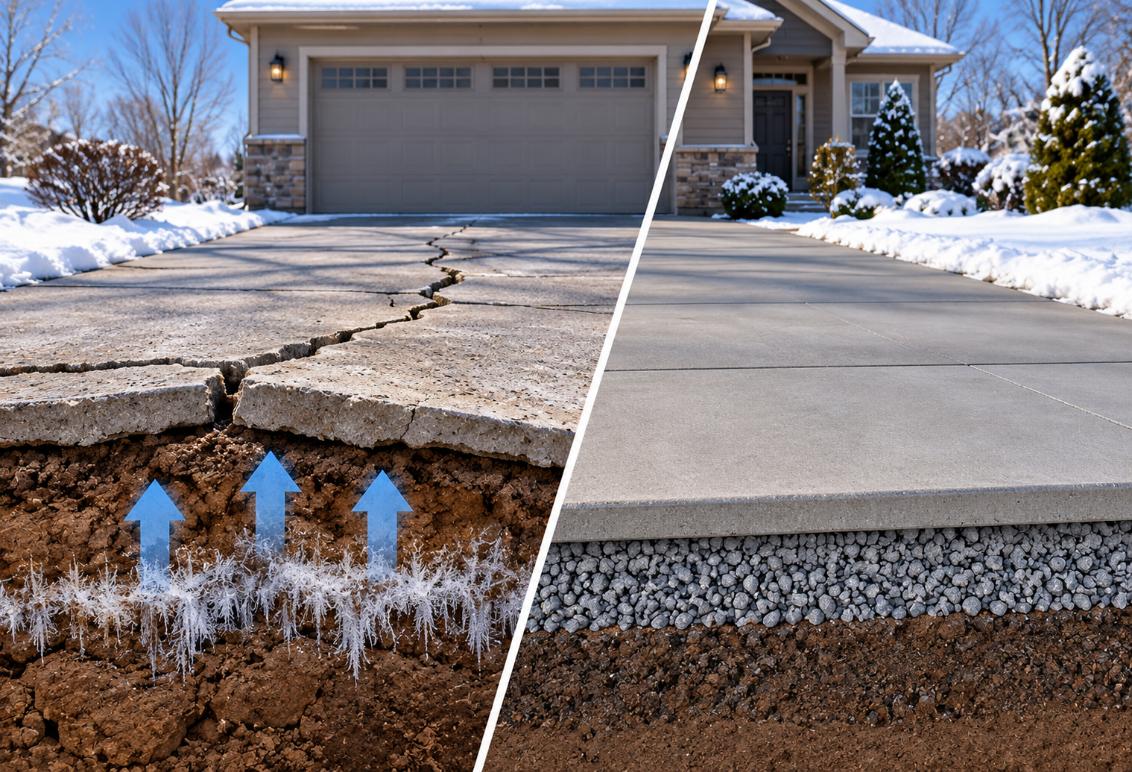
The problem is not simply cold weather. Frost heave becomes especially damaging when moisture collects beneath pavement, freezes, expands, and pushes the driveway upward. When the ground thaws, unsupported or uneven pavement can settle and crack.
Quick answer: Preventing frost-heave cracking starts below the driveway surface. Proper excavation, a stable aggregate base, effective drainage, suitable pavement thickness, and timely crack maintenance can reduce the conditions that allow frost movement to damage asphalt. In Waukegan and nearby North Chicago, paying attention to water movement is especially important because clay-rich soils can hold moisture rather than allowing it to drain quickly.
What local property owners should know
-
Clay-heavy soil can retain moisture beneath a driveway, creating conditions that contribute to frost heave when temperatures drop.
-
Lake County properties experience repeated winter freezing and thawing, which can stress pavement and its supporting base.
-
Low spots, poor grading, and downspout discharge near a driveway can increase the amount of water reaching the pavement foundation.
-
Cracks should be addressed before they provide additional pathways for rain, snowmelt, and ice to reach the base.
-
A long-term paving solution should address the driveway structure and drainage conditions, not simply cover visible surface damage.
Why Does High-Clay Soil Increase Frost-Heave Risk?
High-clay soil can increase frost-heave risk because it tends to retain water, and that moisture can freeze beneath pavement during northern Illinois winters. As freezing conditions penetrate the ground, moisture within susceptible soil and base materials can contribute to upward movement. Thawing can then leave portions of the pavement inadequately supported.
That cycle matters in Waukegan because winter temperatures can repeatedly move above and below freezing. Snow accumulation followed by melting can introduce additional moisture around pavement edges and cracks.
Properties closer to Lake Michigan, as well as those around North Chicago and other parts of northeastern Lake County, may have different drainage and soil conditions from one lot to another. The condition of the existing base therefore matters just as much as what is visible at the asphalt surface.
Real Paving helps property owners evaluate paving problems with those local conditions in mind. We look beyond the visible crack to consider whether drainage, base stability, or pavement deterioration may be contributing to the problem.
What Do Local Conditions Tell Us About Driveway Damage?
Local conditions show that driveways in northeastern Illinois must be prepared for moisture, snow, freezing temperatures, and repeated freeze-thaw cycles. These environmental stresses make drainage and base preparation important parts of protecting pavement over the long term.
For homeowners in Waukegan, the practical lesson is straightforward: water beneath the pavement can be as important as water on top of it. A driveway may appear reasonably sound during summer but show new cracks, raised areas, or settlement after winter.
Around communities such as North Chicago, Gurnee, Beach Park, and Zion, similar seasonal conditions make it worthwhile to watch how water drains around paved surfaces during heavy rain and spring snowmelt.
How Does Frost Heave Affect a Driveway?
Frost heave can lift sections of a driveway unevenly, creating cracks, bumps, depressions, and weakened pavement as the ground freezes and thaws. Repeated movement can turn relatively small defects into larger areas of deterioration, particularly when water continues entering through open cracks.
The impact can include rough vehicle transitions, standing water, widening cracks, and deterioration along pavement edges. Movement can also become more noticeable where a driveway meets a garage slab, sidewalk, apron, or other relatively fixed surface.
For Waukegan homeowners, early inspection can help distinguish ordinary surface aging from damage that may involve the pavement base or drainage.
What Are the Warning Signs of Frost-Heave Problems?
Common frost-heave warning signs include new winter cracking, raised pavement, uneven settlement, recurring depressions, and cracks that return after previous surface repairs. Problems that appear or worsen after freezing weather deserve particular attention.
Watch for:
-
Cracks that noticeably widen after winter.
-
Raised or buckled sections of asphalt.
-
Low spots that collect rainwater or snowmelt.
-
Repeated cracking in the same location.
-
Separation where the driveway meets another paved surface.
-
Crumbling or unsupported driveway edges.
-
Depressions that develop after spring thaw.
-
Water consistently draining toward rather than away from the driveway.
A single small crack does not automatically mean severe frost heave. Patterns of recurring movement are more useful clues.
When Should You Call a Paving Professional?
Call a paving professional when cracking is recurring, pavement is visibly moving, drainage problems are persistent, or damaged areas appear to involve the base beneath the asphalt. Minor surface conditions can be monitored, but structural movement usually deserves a closer evaluation.
Homeowners can safely observe drainage during rainfall, keep debris from blocking water flow, and note whether cracks change after winter. More extensive excavation, base correction, grading, and pavement replacement should be evaluated professionally.
In Waukegan, an assessment before severe winter weather or after the spring thaw can provide a clearer picture of how a driveway is performing.
What Commonly Causes Frost-Related Driveway Cracking?
The most common contributors are moisture beneath the pavement, frost-susceptible soil, inadequate base support, poor drainage, and existing cracks that allow more water into the driveway structure. Several of these conditions can occur together on the same Lake County property.
-
Moisture-retaining soil: Clay-rich ground can hold water beneath paved areas.
-
Poor surface drainage: Low spots or improper grading can keep water close to the driveway.
-
Insufficient base preparation: A weak or poorly draining base can make pavement more vulnerable to soil movement.
-
Open cracks: Existing cracks create pathways for water to enter the pavement structure.
-
Edge drainage problems: Water entering along unsupported or deteriorating edges can weaken surrounding material.
-
Repeated freeze-thaw cycles: Seasonal temperature swings repeatedly stress already vulnerable pavement.
The visible crack is often the symptom. The long-term solution depends on understanding what is happening underneath it.
How Can Homeowners Reduce Frost-Heave Damage?
Homeowners can reduce frost-heave damage by controlling water, maintaining cracks, protecting pavement edges, and correcting underlying base problems when necessary. Preventive work is most effective when it limits moisture before freezing weather arrives.
Before winter, inspect the driveway for open cracks, depressions, and areas where water collects. Check nearby downspouts and grading so runoff is not being directed beneath the pavement. During winter, avoid damaging weakened pavement edges when removing snow.
Spring is another useful inspection period. Once the ground thaws, look for new movement or cracks that changed significantly during the cold season.
DIY observation and basic housekeeping are useful, but they cannot correct a failing aggregate base or significant subsurface drainage problem.
What Results Can You Expect From Proper Driveway Work?
Proper driveway work should create more stable support, improve surface performance, and reduce avoidable water-related stress, although no outdoor pavement can be made immune to soil movement or weather. The appropriate result depends on whether the driveway needs maintenance, localized repair, or more extensive reconstruction.
For a driveway with limited surface deterioration, maintenance may help slow additional damage. Where frost movement has affected the supporting structure, simply covering the area may not address the underlying cause.
That distinction is particularly important for properties exposed to Waukegan’s winter freeze-thaw conditions.
What Mistakes Make Frost-Heave Damage Worse?
The biggest mistakes are treating every crack as a surface-only problem, allowing drainage issues to continue, and waiting until widespread pavement failure develops. A better approach considers both the visible damage and the conditions beneath and around the driveway.
Mistake: Repeatedly patching an area that keeps moving.
Consequence: The crack or depression may return because the underlying condition remains.
Better approach: Determine whether base instability or water is contributing.
Mistake: Letting downspouts discharge beside the pavement.
Consequence: Additional moisture may reach frost-susceptible soil.
Better approach: Direct runoff appropriately away from vulnerable paved areas.
Mistake: Ignoring small cracks through multiple winters.
Consequence: Water can enter and contribute to further deterioration.
Better approach: Inspect and maintain pavement before defects become more extensive.
What Does a Common Local Frost-Heave Scenario Look Like?
A common local scenario involves a driveway that looks relatively stable in summer but develops a raised area or wider crack after a wet fall and freezing winter. Snowmelt or drainage may repeatedly feed moisture into the same location, while clay-rich soil and freezing conditions contribute to movement below the asphalt.
This is a general Waukegan-area scenario, not a specific Real Paving project. The correct repair would depend on the driveway’s condition, drainage, base, and extent of deterioration.
Which Paving Services Can Address These Problems?
The right paving solution depends on whether the damage is limited to the surface or extends into the driveway’s supporting structure. Crack maintenance may be appropriate for some conditions, while failed areas can require more substantial repair or replacement.
When structural problems are present, proper preparation of the underlying area becomes critical. Drainage and grading should also be considered so a newly repaired or paved surface is not exposed to the same avoidable moisture problem.
How Do Repair and Replacement Compare?
Repair is generally better suited to localized damage, while replacement becomes more relevant when deterioration or base problems affect substantial portions of the driveway. The decision should be based on pavement condition, recurring movement, drainage, and the integrity of the supporting material.
A short-term surface repair can make sense when the surrounding pavement remains sound. If cracks repeatedly return across multiple areas, addressing the larger pavement structure may provide a more appropriate path.
Where Do We Serve?
We serve property owners in Waukegan and can discuss paving needs in surrounding communities based on project location and service availability. Nearby Lake County communities include North Chicago, Gurnee, Beach Park, and Zion.
Property owners should contact us to confirm service availability for their specific address.
What Can Happen If Frost-Heave Damage Is Ignored?
Ignoring frost-heave damage can allow cracks, water intrusion, settlement, and surface deterioration to become more extensive over additional freeze-thaw seasons. Waiting does not guarantee major failure, but recurring movement can make a limited pavement problem more difficult to address later.
The best time to evaluate a questionable area is before deterioration becomes widespread or interferes with normal driveway use.
FAQ
Does clay soil automatically mean my driveway will crack?
No. Clay-rich soil can increase susceptibility to moisture-related movement, but driveway performance also depends on drainage, base preparation, pavement condition, and site-specific soil characteristics. A properly constructed pavement system is designed to manage the conditions beneath it rather than relying on the asphalt surface alone.
Why does my Waukegan driveway look worse after winter?
Freeze-thaw conditions can expose existing weaknesses in a Waukegan driveway. Moisture beneath or within the pavement structure may freeze and contribute to movement, while thawing can leave weakened or uneven support. Winter weather can also widen existing cracks and allow additional water to enter.
Can frost heave be prevented completely in Lake County?
No outdoor driveway can realistically be guaranteed against all frost-related movement in Lake County. Good drainage, appropriate base preparation, sound paving practices, and timely maintenance can reduce avoidable risk. Site-specific soil and moisture conditions still influence how pavement performs through repeated winters.
Is a raised driveway section always caused by frost heave?
No. A raised or uneven section can have several possible causes, so the pavement and surrounding conditions should be evaluated before assuming frost heave is responsible. Timing can provide a clue. Movement that appears after freezing weather may warrant investigation of moisture, drainage, soil, and base conditions.
When should I inspect my driveway in Waukegan?
Inspecting a Waukegan driveway in fall and again after spring thaw can help reveal seasonal changes. Before winter, look for open cracks and drainage problems. In spring, check for new cracking, settlement, raised pavement, or depressions that may have developed during freeze-thaw cycles.
Does sealing a crack fix frost heave?
Crack maintenance can help limit water entry, but it does not repair an unstable base or eliminate frost-susceptible soil. If the pavement repeatedly moves or the same crack returns, the underlying support and drainage may need attention rather than another surface-only treatment.
Are North Chicago driveways affected by the same freeze-thaw problems?
Yes. North Chicago experiences the same broader northeastern Illinois winter conditions that can expose pavement to freezing, thawing, snowmelt, and moisture. Actual driveway performance varies by property, so drainage, soil conditions, pavement age, and base construction should be evaluated individually.
Should I repair my driveway before winter or wait until spring?
The best timing depends on the type and severity of damage. Addressing open cracks and drainage concerns before winter may help reduce water intrusion, while spring can reveal movement that occurred during freezing conditions. Significant structural damage should be professionally evaluated rather than postponed solely because of the season.
Protect Your Driveway From Another Freeze-Thaw Season
Local soil, drainage, and winter weather all influence how a driveway performs over time. We can help you evaluate visible pavement problems and determine which paving approach fits the condition of your property.