
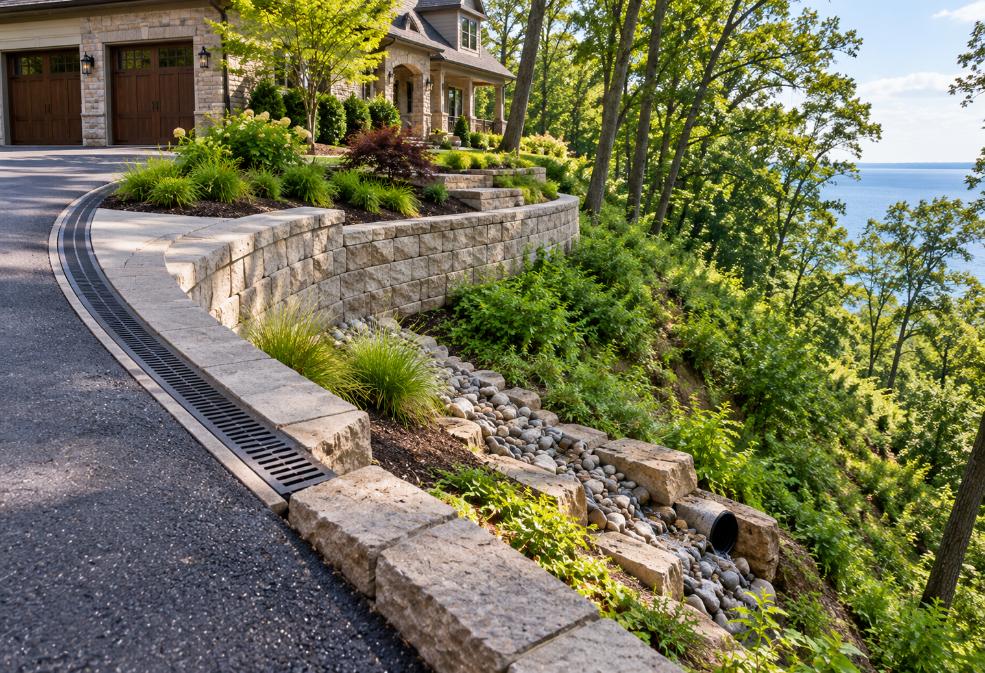
Properties near ravines can offer beautiful wooded views and distinctive landscapes, but steep grades also create drainage challenges. In Lake Bluff, heavy rain, snowmelt, freeze-thaw cycles, and runoff from roofs and paved surfaces can gradually move soil downhill, wash out landscaping, and undermine pavement.
The key to managing ravine slope erosion is controlling water before trying to hold soil in place. Retaining walls can stabilize appropriate portions of a slope, while properly designed driveway drainage helps intercept and redirect concentrated runoff. Because every ravine property has different grades, soils, pavement layouts, and drainage paths, the best solution starts with understanding where the water comes from and where it can safely go.
What local property owners should know
-
A retaining wall and a drainage system perform different jobs, and many sloped properties need both working together.
-
Runoff flowing from driveways, downspouts, and hardscaped areas can become especially damaging when it concentrates near a ravine edge.
-
Lake County’s seasonal rain, snow, frozen ground, and thawing conditions can expose drainage weaknesses that are less noticeable during dry weather.
-
Cracked pavement, washed-out soil, leaning walls, and recurring sediment movement are signs that water should be investigated rather than simply covered up.
-
Drainage improvements should move water to an appropriate discharge location without creating a new erosion problem farther downhill.
Why Does Ravine Slope Erosion Matter for Lake Bluff Properties?
Ravine slope erosion matters because uncontrolled runoff can affect landscaping, retaining structures, pavement, and the stability of soil around developed portions of a property. Near the Lake Michigan shoreline and the ravine systems of northeastern Illinois, water moving across steep terrain can concentrate quickly and repeatedly disturb exposed soil.
Properties around the North Shore often combine mature trees, sloping lots, older improvements, driveways, patios, and roof drainage systems. Those features influence how rainfall and snowmelt travel across a site.
A driveway that appears relatively flat near the street, for example, may direct a large volume of runoff toward a side yard or ravine once water reaches its low point. Likewise, a retaining wall can experience unnecessary pressure if water accumulates behind it instead of draining properly.
Real Paving helps property owners evaluate paving and drainage concerns associated with these challenging sites. From this point forward, we focus on how pavement, grading, drainage, and retaining solutions can work together rather than treating visible erosion as an isolated problem.
What Do Local Conditions Tell Us About Ravine Drainage?
Local conditions show that ravine drainage must account for repeated wetting, freezing, thawing, and runoff rather than one isolated storm. Lake County’s location along Lake Michigan brings seasonal precipitation and winter conditions that can repeatedly test slopes, paved surfaces, drainage outlets, and retaining structures.
For property owners, field observations can be just as important as looking at the slope itself. Water stains, sediment deposits, exposed roots, pavement edge deterioration, and channels carved into soil can reveal the routes water follows during wet weather.
One useful inspection strategy is to observe the property during or shortly after moderate rainfall. Without entering an unstable slope, note where water leaves the driveway, whether downspouts discharge toward the ravine, and whether runoff becomes concentrated at one point.
How Can Erosion Affect a Local Property?
Erosion can gradually remove support from landscaping, pavement edges, retaining structures, and other improvements near a slope. The effects may begin with small washed-out areas but become more difficult to address if runoff continues following the same path during storms and spring snowmelt.
For Lake Bluff homeowners, a drainage problem near a driveway can also affect everyday use. Sediment may collect on pavement, aggregate can wash away along edges, low areas can remain wet, and cracks may worsen as water enters vulnerable areas and freezes.
The goal is not simply to make water disappear from one spot. A successful drainage plan manages the entire path from collection to discharge.
What Are the Warning Signs of a Ravine Drainage or Slope Problem?
Warning signs of ravine drainage problems include moving soil, concentrated runoff, pavement deterioration, and changes in retaining structures. Property owners should pay particular attention when several of these symptoms appear in the same area.
-
Small channels or gullies repeatedly form after rainfall.
-
Soil or mulch washes onto the driveway or downhill toward the ravine.
-
The driveway edge is cracking, settling, or losing support.
-
Water consistently crosses the pavement instead of reaching a drainage system.
-
A retaining wall is leaning, bulging, cracking, or separating.
-
Soil behind a wall remains unusually wet or washes through joints.
-
Downspouts or drainage pipes discharge directly onto an erosion-prone slope.
-
Previously buried roots, stones, or foundation elements become increasingly exposed.
A single symptom does not identify the underlying cause. Repeated or accelerating changes are a stronger reason to have the site evaluated.
When Should You Call a Professional?
A professional should evaluate the property when erosion is recurring, pavement is losing support, a retaining wall is moving, or drainage needs to be redirected near a steep slope. These conditions can involve more than surface landscaping and may require coordinated grading, drainage, paving, or structural work.
Homeowners can safely monitor water flow from stable ground, keep accessible drains free of leaves, and look for changes after storms. DIY work should stop when it involves excavating near a steep ravine, altering a structural retaining wall, changing major drainage patterns, or working where soil movement could create a safety hazard.
For complex sites, additional engineering, permitting, or municipal review may also be appropriate before construction begins.
What Commonly Causes Ravine Slope Erosion?
The most common causes of ravine slope erosion are concentrated runoff, poor drainage paths, disturbed soil, steep grades, and repeated weather exposure. On North Shore properties, several causes can overlap and amplify one another.
1. Driveway runoff: A paved driveway sheds water instead of absorbing it. If its pitch directs water toward one low point, runoff can leave the pavement with enough concentration to erode adjacent soil.
2. Roof drainage: Downspouts that empty near a slope can repeatedly saturate or scour the same area.
3. Freeze-thaw conditions: Water entering soil and pavement during winter can contribute to movement and deterioration as temperatures cycle above and below freezing.
4. Inadequate retaining-wall drainage: A wall may retain soil, but water still needs an appropriate route out from behind the structure.
5. Changes in grading or landscaping: Altering planting beds, pavement, patios, or other surfaces can change established drainage patterns.
6. Natural slope conditions: Ravines are dynamic landscapes. A steep slope should not automatically be treated like a conventional flat residential yard.
How Can Property Owners Help Prevent Erosion?
Property owners can help prevent erosion by controlling runoff early, maintaining drainage components, protecting vulnerable soil, and correcting pavement drainage before small problems become established channels. Seasonal inspections are especially useful before spring snowmelt and after periods of substantial rainfall.
Keep driveway drains, catch basins, and accessible outlets clear of leaves and debris. Check downspout discharge locations and watch for water flowing across pavement or concentrating along its edges.
Landscaping can help protect appropriate areas of exposed soil, but vegetation should not be treated as a substitute for correcting concentrated runoff. If large volumes of water are being directed toward the ravine, the source and drainage route should be evaluated first.
What Results Can Retaining Wall and Drainage Improvements Provide?
Properly planned retaining wall and drainage improvements can reduce concentrated runoff, support vulnerable grade transitions, and protect nearby pavement from water-related deterioration. The exact result depends on the site’s slope, existing drainage, soil conditions, structures, and the source of the water.
A drainage improvement might involve collecting water before it crosses a vulnerable area, adjusting pavement grading, incorporating drainage structures, or creating a more controlled route to an appropriate discharge point.
A retaining wall may help manage a grade change, but it should not be expected to solve uncontrolled water flow by itself. Drainage and structural needs should be considered together.
What Mistakes Should Lake Bluff Property Owners Avoid?
The biggest mistake is treating visible erosion without addressing the water causing it. A temporary cosmetic repair may disappear during the next significant runoff event if the drainage pattern remains unchanged.
Mistake: Adding soil to a washed-out area.
Consequence: New material may wash away along the same path.
Better approach: Determine why water is concentrating there first.
Mistake: Building a wall without considering drainage.
Consequence: Water can accumulate behind or around the structure.
Better approach: Plan soil retention and water management as parts of the same project.
Mistake: Sending driveway water directly downhill.
Consequence: Concentrated discharge may move the erosion problem to another part of the property.
Better approach: Evaluate collection, conveyance, and discharge together.
Mistake: Waiting for major pavement failure.
Consequence: Continued loss of edge support or base material can increase the scope of needed work.
Better approach: Investigate recurring cracks, settlement, or washout while the affected area is still limited.
What Does a Common Local Ravine Scenario Look Like?
A common local scenario involves a sloped driveway that collects runoff from pavement and nearby roof drainage, then releases that water near a landscaped ravine edge. Over time, the discharge point begins losing soil, while the driveway shoulder shows cracking or settlement.
This is an illustrative Lake Bluff scenario, not a specific Real Paving project. Instead of simply filling the eroded area, a comprehensive evaluation would trace the water from its sources, examine driveway pitch and drainage opportunities, assess the grade transition, and determine whether retaining measures are appropriate.
That approach addresses the system rather than one symptom.
Which Services Can Help Control Driveway Runoff and Erosion?
Drainage, paving, grading, and appropriate retaining solutions can work together to manage runoff and protect developed areas near a slope. The right combination depends on whether the primary problem begins on the driveway, at a drainage outlet, behind a wall, or elsewhere on the property.
We can evaluate how the paved surface interacts with the surrounding grade and discuss practical options for improving water movement. Where a project involves conditions beyond paving and drainage work, additional professional evaluation may be necessary.
How Do Retaining Walls and Drainage Solutions Compare?
Retaining walls primarily manage grade and soil, while drainage systems manage water. Choosing one without evaluating the other can leave the underlying site problem unresolved, particularly on a ravine property.
A surface repair may make sense for minor localized deterioration after the water source has been corrected. Drainage improvements are more appropriate when runoff is consistently following a damaging path. Retaining solutions may be considered where a grade transition requires support.
For complicated ravine conditions, a coordinated professional approach is generally more appropriate than piecemeal DIY changes because altering one part of the drainage path can affect another.
What Areas Can Benefit From These Drainage Solutions?
Properties in Lake Bluff and surrounding North Shore communities can experience similar challenges where paved surfaces meet sloped terrain. Nearby areas such as Lake Forest, Highland Park, and other parts of Lake County also contain properties where topography and seasonal runoff make careful drainage planning valuable.
Site conditions still vary significantly from one property to another, so solutions should be based on the actual grade and water path rather than assumptions about the neighborhood.
What Can Happen If Ravine Erosion Is Ignored?
Ignoring recurring ravine erosion can allow water to remove more soil, undermine pavement edges, worsen drainage channels, and increase stress around retaining structures. Waiting does not guarantee severe damage, but repeated runoff can make a previously localized problem more extensive.
The practical reason to act early is to understand the source before additional repairs become necessary. If soil keeps disappearing from the same location after storms, replacing the soil repeatedly is unlikely to address the underlying drainage problem.
FAQ About Ravine Erosion and Driveway Drainage
Do all ravine properties need a retaining wall?
No, not every ravine property needs a retaining wall. The appropriate solution depends on slope geometry, soil conditions, erosion location, existing improvements, and drainage patterns. Some properties may primarily need better runoff control, while others may require retaining measures or additional professional evaluation.
Why does water run off my Lake Bluff driveway so quickly?
Pavement does not absorb rainfall like landscaped ground, so water travels according to the driveway’s pitch and low points. On a sloped Lake Bluff property, that runoff can become concentrated before leaving the pavement, making the discharge location particularly important for erosion control.
Can a retaining wall stop erosion near a ravine?
A retaining wall can help manage soil and a change in grade, but it does not automatically stop erosion caused by uncontrolled water. If runoff continues flowing around, over, or behind the wall, drainage problems can persist. Water management should therefore be considered during retaining-wall planning.
Does winter weather affect driveway drainage in Lake County?
Yes, winter conditions can expose drainage and pavement vulnerabilities in Lake County. Snowmelt introduces water, while freezing and thawing can contribute to movement where moisture enters soil or pavement. Checking drainage before winter and again during spring can help identify recurring problem areas.
Should I route a downspout toward the ravine?
A downspout should not simply be redirected toward a ravine without considering the discharge point and potential erosion. Concentrated roof runoff can scour soil even when moving water away from the house. The entire drainage route should be evaluated so one problem is not exchanged for another.
Can driveway drainage protect pavement near a slope?
Yes, appropriate driveway drainage can help protect pavement by reducing uncontrolled water flow across the surface, edges, and supporting areas. The system must match the driveway’s actual elevations and runoff pattern. Correct drainage is particularly valuable where pavement borders a significant downhill grade.
When should a leaning retaining wall be inspected?
A leaning, bulging, cracking, or separating retaining wall should be evaluated rather than treated as a cosmetic issue. Changes can be related to drainage, soil pressure, construction conditions, or other factors. A wall near a ravine deserves particular caution because surrounding grades may complicate access and repair.
Are permits required for retaining or drainage work in Lake Bluff?
Permit requirements depend on the scope, location, and type of work, particularly where grading, drainage, retaining structures, or sensitive areas are involved. Property owners should confirm current requirements with the appropriate local authorities before construction rather than assuming a small-looking project is exempt.
Protect Your Property With a Better Drainage Plan
Ravine properties require thoughtful water management because pavement, steep grades, seasonal weather, and soil movement are closely connected. We can help evaluate how driveway drainage and related paving solutions fit into a practical plan for protecting your property.
Address Runoff Before It Becomes a Larger Property Problem
A site-specific evaluation can help identify where water is coming from, where it is causing trouble, and which improvements deserve priority.