
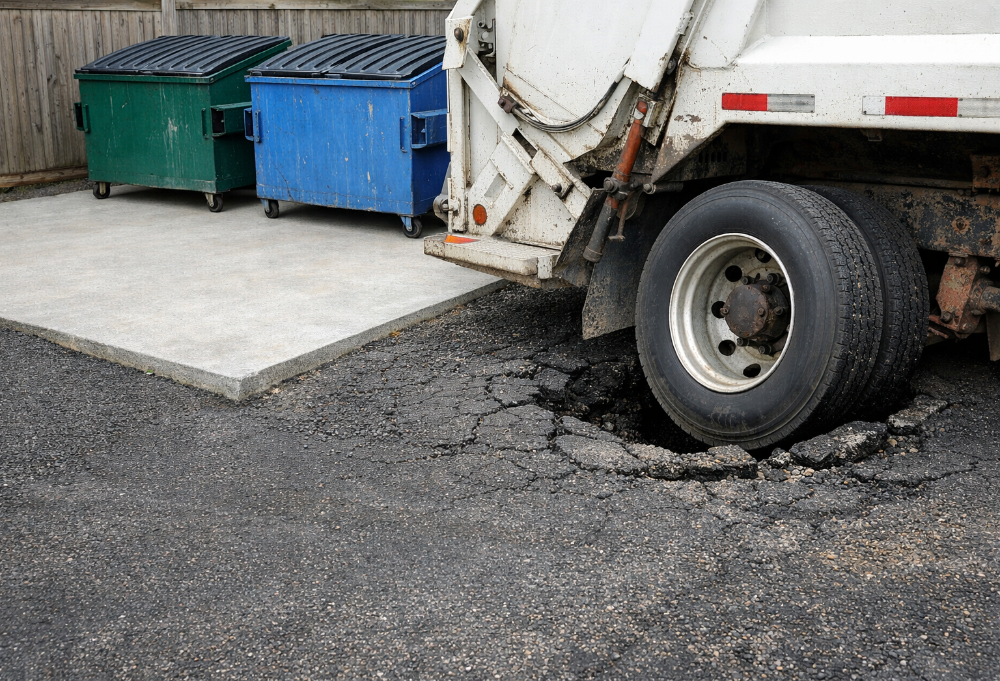
If you manage a commercial property in Lake County, IL, you have probably seen it before: a garbage truck pulls up, the driver positions the vehicle over the dumpster pad, and by the time the truck leaves, there are two fresh ruts pressed into the pavement. The asphalt has given way under the weight, and now you have a new repair bill sitting on your desk. This is one of the most common and most preventable problems in commercial property maintenance, and it comes down to one fundamental decision made during installation.
The choice between concrete and asphalt for your dumpster pad is not just about upfront cost. It is about understanding how each material behaves under repeated heavy loads, what the long-term maintenance picture looks like, and which surface will actually protect your property investment over time. A qualified commercial concrete contractor in Lake County, IL can walk you through the specifics for your site, but this guide will give you the foundation you need to make an informed choice.
Dumpster Pads Take a Beating Unlike Any Other Surface
To understand the problem, you have to think about what a dumpster pad actually endures. A standard rear-load garbage truck can weigh anywhere from 33,000 to 70,000 pounds when fully loaded. That weight is not distributed evenly across a large surface area the way it might be on a highway. Instead, it is concentrated on a relatively small set of axles and wheels, pressing down repeatedly on the same patch of pavement, week after week, year after year.
Add to that the thermal conditions in Northern Illinois. Summers in Lake County push surface temperatures high enough to soften certain paving materials, and winters bring freeze-thaw cycles that compromise the structural integrity of any surface that was not installed correctly. When you combine extreme weight concentration with temperature extremes, you get the conditions that cause asphalt rutting, cracking, and that infamous sunken truck problem that so many property managers know well.
This is also why heavy duty paving for loading docks and similar high-stress areas requires a different design approach than standard parking lot construction. The engineering has to account for static and dynamic loads that regular pavement was never intended to handle.
The Case for Asphalt: Where It Works and Where It Fails
Asphalt has genuine advantages in certain applications. It is less expensive to install upfront, it can be laid quickly, and in climates like Northern Illinois it does offer some flexibility that can resist cracking under freeze-thaw conditions better than a poorly designed concrete slab. For general parking lots and low-traffic drives, asphalt is often a perfectly reasonable choice.
The problem starts when asphalt is used in applications that demand load-bearing performance it simply cannot deliver. Asphalt is a flexible pavement, meaning it is designed to bend slightly under load. Under normal conditions, that flexibility is a feature. Under the concentrated, repeated weight of a garbage truck, it becomes a liability. The material deforms, and once it starts to rut, the damage compounds with every subsequent truck visit.
Asphalt rutting repair is a recurring expense for many commercial property owners who installed asphalt dumpster pads without fully considering the load requirements. You can patch the ruts, but if the underlying mix and base were not designed for heavy vehicle traffic, the ruts will return. Some contractors offer asphalt mixes with higher stiffness ratings for heavy-duty applications, and these do perform better, but they still fall short of what a properly engineered concrete pad can deliver over a 20 to 30 year lifespan.
Concrete Dumpster Pad Installation: The Long-Term Solution
Concrete dumpster pad installation is the standard recommendation for commercial properties that deal with regular heavy truck traffic. Unlike asphalt, concrete is a rigid pavement. It does not deform under load; instead, it distributes the weight across the slab. When the design and installation are done correctly, a concrete pad can handle garbage trucks, delivery vehicles, and even semi-trucks without rutting, sinking, or requiring constant repair.
The key variables in a quality concrete dumpster pad installation are slab thickness, reinforcement, base preparation, and mix design. For standard commercial dumpster applications, a 6-inch slab is often the minimum, but high-traffic or heavier load scenarios may call for 8 inches or more. Reinforcing the slab with rebar or wire mesh adds tensile strength that helps the concrete resist cracking under load and during freeze-thaw cycles.
Base preparation is equally critical and often where corners get cut. A well-compacted aggregate base, typically 6 to 8 inches of crushed stone, ensures proper drainage and a stable foundation that will not shift seasonally. Poor base prep is one of the most common reasons concrete pads fail prematurely, and it is something a reputable commercial concrete contractor in Lake County, IL will address explicitly in their scope of work.
Finally, the concrete mix itself matters. Higher PSI mixes (4,000 PSI is a common standard for heavy-duty commercial work) offer greater compressive strength and durability. Air entrainment in the mix helps the concrete survive freeze-thaw cycles without scaling or spalling, which is essential for any flatwork in Northern Illinois.
Comparing Total Cost of Ownership: Upfront vs. Long-Term
When commercial property owners push back on concrete dumpster pad installation because of the higher upfront cost, the conversation needs to shift to total cost of ownership. Yes, concrete costs more to install than asphalt. Depending on the size of the pad and site conditions, the difference can be significant. But that comparison only tells part of the story.
An asphalt dumpster pad that requires asphalt rutting repair every two to three years, resurfacing every five to seven years, and eventual full replacement within 10 to 15 years will cost considerably more over its service life than a concrete pad that, with minimal maintenance, will last 25 to 40 years. When you factor in the labor and disruption of repeated repairs, the economics of concrete become even more compelling for high-use applications.
The same logic applies to heavy duty paving for loading docks, drive approaches, and other areas that see consistent heavy vehicle traffic. The goal is not to find the cheapest material; it is to find the material that delivers the best performance per dollar over the life of the installation. For most commercial dumpster pad applications in Lake County, IL, that material is concrete.
Choosing the Right Contractor for the Job
Even the best material will fail if it is installed incorrectly, which is why choosing a qualified commercial concrete contractor is just as important as the material decision itself. In Lake County, IL, where weather conditions create real challenges for concrete placement and curing, you want a contractor with demonstrated experience in commercial flatwork and a clear process for site preparation, forming, reinforcement, placement, and finishing.
Ask prospective contractors about their base preparation process, their mix specifications, and how they handle curing in variable weather conditions. A contractor who can answer those questions clearly and specifically is one who understands the craft. Ask for references from similar commercial projects and, if possible, go look at their work.
Also clarify what the finished pad will look like at the joints. Proper joint placement controls where the concrete cracks (and it will crack; the goal is to control where). Joints should be cut or formed at regular intervals to prevent random cracking, and the edges of the pad should be finished in a way that prevents chipping and deterioration over time.
Conclusion
The sunken truck problem has a straightforward solution: stop installing flexible pavement in applications that demand rigid, load-bearing performance. Concrete dumpster pad installation, done correctly by an experienced commercial concrete contractor in Lake County, IL, delivers decades of reliable service with minimal maintenance. The upfront investment is higher, but the long-term math is clear. If your property deals with regular garbage truck or delivery vehicle traffic, concrete is the right material for the job.
Need a Residential and Commercial Paving Contractor Near You?
At Real Paving, we’re proud to be your trusted paving partner in Zion, Illinois, offering top-tier asphalt, concrete, brick, and stone solutions designed to last and impress. Our team is committed to delivering beautiful, durable results tailored to your specific project, whether it’s a new driveway, parking lot, or resurfacing work. We’d love to help make your next exterior construction project a success — reach out to us today for a free estimate, and let’s pave the way together!