
When utility crews finish their underground work, they leave behind something that every property owner dreads: an open trench cut straight through an otherwise functional asphalt surface. Whether the job involved replacing a water main, rerouting electrical conduit, or repairing a gas line, the pavement above it needs to be restored correctly. For commercial properties across Lake County, IL, this kind of repair is more than a cosmetic fix. It directly affects structural integrity, drainage performance, liability exposure, and the long-term lifespan of your entire paved surface.
Understanding how utility trench patching asphalt is done properly will help you make smarter decisions when it is time to call in a professional crew.
Why Trench Cuts Are More Complicated Than They Look
A fresh trench cut in a commercial parking lot or roadway is not just a hole that needs to be filled. The excavation process disrupts the compacted subbase layers that were originally engineered to support the weight of vehicles over many years. When crews dig down to access a water line or utility conduit, they disturb not only the asphalt surface but also the aggregate base and, in many cases, the subgrade soil beneath it.
If those layers are not properly restored before new asphalt is placed, the patch will fail within months. You will see cracking along the edges of the repair, depression settling in the center, and water infiltration that accelerates deterioration of the surrounding pavement. This is one of the most common complaints property managers have after utility work is completed: the patch looks fine for a season, then it begins to fail dramatically.
Experienced commercial paving contractors in Zion, IL and throughout the surrounding region understand that a trench patch is really a full-depth pavement reconstruction project in a narrow footprint. It requires the same attention to compaction, drainage, and material selection as any new paving job.
The Step-by-Step Process for a Lasting Asphalt Trench Repair
Doing trench patching right starts well before the first shovel of hot mix asphalt goes into the ground. The first step is sawcutting clean, straight edges around the disturbed area. Ragged or tapered edges are weak points where cracking almost always originates. A clean vertical cut gives the new asphalt a solid interface to bond against.
Next, the subbase must be evaluated and rebuilt. If the original excavation removed or loosened the compacted aggregate base, that material needs to be replaced in lifts and compacted with appropriate equipment. Skipping this step or rushing through it is the primary reason trench patches fail prematurely. The compaction process eliminates air voids in the base material and ensures the repair can handle repeated vehicle loading without settling.
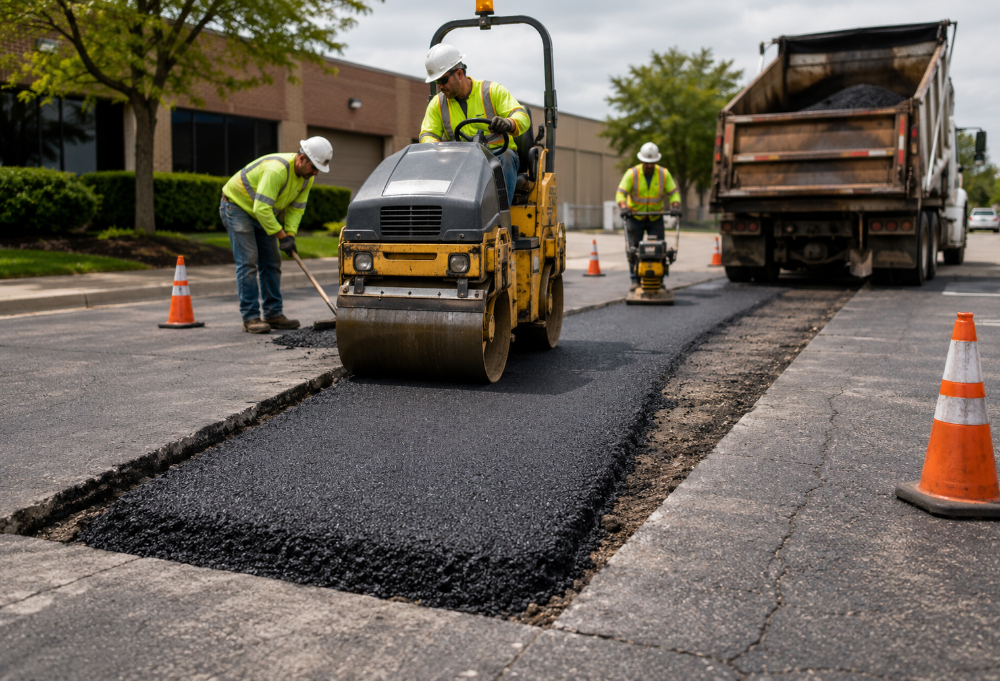
Once the base is prepared, asphalt is placed in lifts appropriate to the depth of the repair. Deeper cutouts require multiple layers, each compacted separately before the next is added. The final surface lift is compacted to match the grade and texture of the surrounding pavement as closely as possible. Tack coat, a thin bonding layer of asphalt emulsion, is applied between lifts and along the sawcut edges to create adhesion between old and new material.
This full process is what separates a professional utility trench patching asphalt repair from a temporary throw-and-roll patch that barely makes it through the first winter.
Material Selection and Mix Design for Commercial Applications
Not all asphalt mixes are appropriate for trench repairs in commercial or industrial environments. Standard residential patching materials are often too fine-graded or too soft to handle the repeated stress of heavy trucks, delivery vehicles, or industrial equipment. For commercial paving services in Lake County, IL, contractors typically specify a dense-graded hot mix asphalt with aggregate sizing and binder content matched to the expected traffic loading.
In high-traffic commercial corridors or industrial yards, a polymer-modified binder may be specified. These modified mixes offer improved resistance to rutting under slow, heavy loads and perform better in the temperature extremes that the Midwest regularly delivers. Cold patch materials, while sometimes used for emergency temporary repairs, are not a long-term solution in any commercial application. They lack the structural properties of properly placed and compacted hot mix asphalt.
For deep repairs, some contractors use a recycled aggregate base mix for the lower lifts as a cost-effective filler before transitioning to a high-quality surface mix in the top layers. This approach balances budget considerations with performance requirements without cutting corners on the structural layer that matters most.
Industrial asphalt overlay is another tool sometimes used in conjunction with trench patching. After individual patches are completed, a thin overlay across a larger section of the affected area can unify the surface, improve drainage flow, and extend the effective life of the surrounding pavement by sealing minor surface distress before it develops further.
Parking Lot Repair Considerations for Property Managers
If you manage a commercial property in Lake County, dealing with the aftermath of utility work in your parking lot involves more than just scheduling a paving crew. The condition of your pavement before the utility cut, the volume of traffic your lot sees daily, and your drainage patterns all factor into how the repair should be scoped.
Parking lot repair in Lake County is also subject to local standards and, in some cases, municipal requirements for how trench repairs must be completed within rights-of-way or easement areas. Working with commercial paving contractors who are familiar with the regulatory environment in Lake County and surrounding municipalities will help you avoid complications during inspection or permit closeout.
It is also worth assessing the broader condition of your pavement at the same time utility work is being completed. If your lot is showing widespread cracking, surface oxidation, or drainage problems independent of the trench cut, this may be the right moment to plan a more comprehensive repair or overlay project. Combining that work with the trench patching avoids the cost of mobilizing a crew twice and results in a more uniform finished surface.
Property managers should also request documentation of the repair process, including base compaction results if the contractor uses testing equipment, material delivery tickets, and photos of each stage of the work. This documentation protects you if questions arise later about the quality of the repair or if additional settling prompts a warranty claim.
Choosing the Right Contractor for Utility Trench Work
The quality of a trench patch is almost entirely determined by the crew performing the work and the standards they hold themselves to. This is not a repair category where the lowest bid reliably delivers acceptable results. Substandard trench patching leads to costly follow-up repairs, surface failures that create liability concerns, and ongoing water infiltration that damages the pavement structure far beyond the original repair area.
When evaluating commercial paving contractors in Zion, IL and across the broader Lake County region, ask specifically about their experience with utility trench patching asphalt on commercial and industrial properties. Request references from similar projects and ask how they handle subbase restoration and compaction verification. A contractor who can speak fluently about those details is one who actually performs the work correctly.
Also confirm that the contractor carries appropriate insurance coverage for commercial work and that their crew is equipped with the right compaction equipment for the job. A plate compactor is not sufficient for deep trench repairs in high-traffic areas. Proper roller equipment and, in some cases, jumping jack compactors for confined areas are part of what a professional repair requires.
Getting It Right the First Time
Utility repairs are an unavoidable part of maintaining the infrastructure beneath any commercial property. The trench cuts they leave behind do not have to become long-term problems. With proper sawcutting, careful subbase reconstruction, appropriate hot mix selection, and skilled compaction, a trench patch can perform as well as the original pavement for a decade or more. Commercial asphalt paving services in Lake County, IL that specialize in this type of work bring the knowledge and equipment needed to restore your surface correctly, protecting your investment and keeping your property safe for the people who use it every day.
Need a Residential and Commercial Paving Contractor Near You?
At Real Paving, we’re proud to be your trusted paving partner in Zion, Illinois, offering top-tier asphalt, concrete, brick, and stone solutions designed to last and impress. Our team is committed to delivering beautiful, durable results tailored to your specific project, whether it’s a new driveway, parking lot, or resurfacing work. We’d love to help make your next exterior construction project a success — reach out to us today for a free estimate, and let’s pave the way together!