
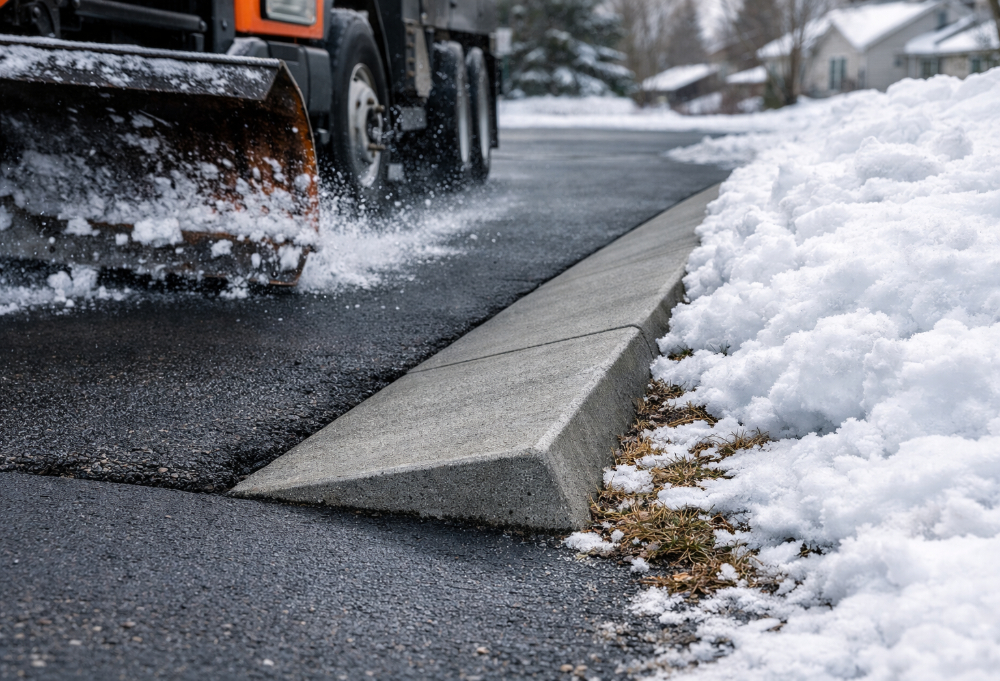
Winter arrives, the plows roll out, and by March, the edges of your driveway look like they lost a fight. Crumbling corners, broken edges, and chunks of asphalt scattered across your lawn are not just eyesores. They are the predictable result of a driveway that was not built to withstand the mechanical forces of a commercial snowplow blade making contact with an unprotected asphalt edge. Homeowners in communities like Barrington and Lake Zurich face this problem every single year, and most of them keep patching the same spots over and over without ever addressing the root cause.
The root cause, in most cases, is the edge angle. Specifically, the absence of a properly executed 45-degree edge tamp during installation or resurfacing. This single detail, often overlooked by budget paving contractors, makes an enormous difference in how long your driveway holds up through a harsh Illinois winter.
What Is Asphalt Edge Tamping and Why Does It Matter?
Asphalt edge tamping is the process of compacting and shaping the outer perimeter of a paved surface so that it transitions from full depth to grade in a controlled, angled way rather than dropping off in a sharp vertical cut. When asphalt is laid and the edges are left with a 90-degree or near-vertical profile, those edges become structurally weak. They carry load without adequate lateral support, and any contact from a plow blade, a vehicle tire, or even freeze-thaw cycling can cause them to fracture and break away.
The 45-degree edge tamp solves this by creating a beveled transition. The outer edge of the mat is compacted at an angle, typically using a hand tamper or a lute and roller combination, so that the asphalt gradually slopes down to meet the surrounding grade. This shape distributes stress across a wider surface area, reduces the leverage a plow blade can exert on the edge, and eliminates the thin, unsupported lip of asphalt that tends to snap off under impact.
For homeowners investing in durable asphalt paving in Barrington, IL, this is not an optional finishing step. It is a structural necessity, especially given the region’s average of 35 or more inches of snowfall per year and the aggressive plowing schedules that come with it.
How Snowplow Damage Actually Happens
Understanding snowplow damage and driveway repair starts with understanding the physics of how a plow interacts with your pavement edge. A municipal or commercial snowplow blade rides at a slight downward angle. As it pushes snow across the surface of a driveway apron or along the length of a private drive, the blade naturally drifts toward low points and exposed edges. When it catches a vertical asphalt edge, even at low speed, it acts like a chisel.
The blade does not just scrape the top. It catches the lip, transmits a shearing force horizontally through the edge, and either chips out a section immediately or creates a stress fracture that widens over the next several freeze-thaw cycles. Water enters the crack, freezes, expands, and pushes the compromised material further apart. By spring, what started as a small chip has become a six-inch crumble running along the length of your driveway.
This pattern repeats on driveways throughout Lake County every single year. The problem is not the plow driver. The problem is a vertical edge profile that gives the blade something to catch. A properly tamped 45-degree bevel gives the blade nowhere to grab. It deflects rather than catches, and the force glances off the slope rather than transferring into the asphalt structure.
Residential Driveway Edging in Lake Zurich: Getting It Right the First Time
Residential driveway edging in Lake Zurich and the surrounding communities involves more than just making the pavement look neat. The edge of a driveway is where the paved surface meets the unpaved world, and it is the most vulnerable zone on any asphalt installation. Getting it right during installation saves homeowners from the cycle of annual patching that otherwise becomes a permanent seasonal expense.
A quality paving contractor will address the edge at multiple stages of the job. During screeding and laying, the crew should allow the asphalt mat to extend slightly beyond the intended edge line. During compaction with the roller, the operator makes passes that bring the drum over the edge, pressing the material down and outward. A hand tamper or lute is then used to shape the bevel precisely, pressing the hot mix down at the correct 45-degree angle before it cools and sets.
The thickness at the outermost point of the bevel should taper from the full mat depth (typically 2 to 3 inches for a residential driveway) down to roughly half an inch or less where it meets the soil. This gradual transition is what gives the edge its structural resilience. It also sheds water more effectively, reducing the pooling that accelerates freeze-thaw damage along the perimeter.
Contractors who skip this step, or who let edges set with a rough vertical cut, are saving themselves a few minutes of labor at the homeowner’s expense. When evaluating a paving quote, ask directly about edge treatment. If the contractor cannot describe a specific process for shaping and compacting the bevel, that is a sign to look elsewhere.
When to Repair vs. When to Rebuild
Not every damaged edge requires a full driveway replacement. The right course of action depends on how far the damage has progressed and what condition the underlying base is in. Minor edge chipping covering a foot or two of linear distance can often be addressed with a hot-mix patch, provided the base is still solid and the surrounding asphalt is intact. A skilled crew will cut back the damaged area to clean, stable material, tack the exposed surface, apply a fresh lift of hot mix, and tamp it into a proper bevel profile.
Snowplow damage and driveway repair becomes a more involved conversation when the crumbling extends along long sections of the edge, when the base is soft or showing signs of sub-base failure, or when the asphalt field itself is heavily oxidized and cracked. In those cases, patching the edge without addressing the underlying conditions will produce a repair that fails again in one or two winters. A full mill and overlay, or in severe cases a complete removal and replacement, may be the only way to restore long-term performance.
A reputable contractor will evaluate the base with probing and visual inspection before recommending a course of action. Be cautious of any company that recommends a full replacement without being able to explain specifically why the base is compromised, and equally cautious of any company that patches an edge sitting over a clearly deteriorated sub-base.
Conclusion
The 45-degree edge tamp is a small detail with an outsized impact on how your driveway performs through an Illinois winter. For homeowners focused on durable asphalt paving in Barrington, IL and neighboring communities, specifying proper edge treatment is one of the most cost-effective decisions you can make. It reduces snowplow damage, slows freeze-thaw deterioration, and extends the functional life of your investment by years. Whether you are installing a new driveway or repairing an existing one, the edge is where durability is either built in or left out.
Need a Residential and Commercial Paving Contractor Near You?
At Real Paving, we’re proud to be your trusted paving partner in Zion, Illinois, offering top-tier asphalt, concrete, brick, and stone solutions designed to last and impress. Our team is committed to delivering beautiful, durable results tailored to your specific project, whether it’s a new driveway, parking lot, or resurfacing work. We’d love to help make your next exterior construction project a success — reach out to us today for a free estimate, and let’s pave the way together!