
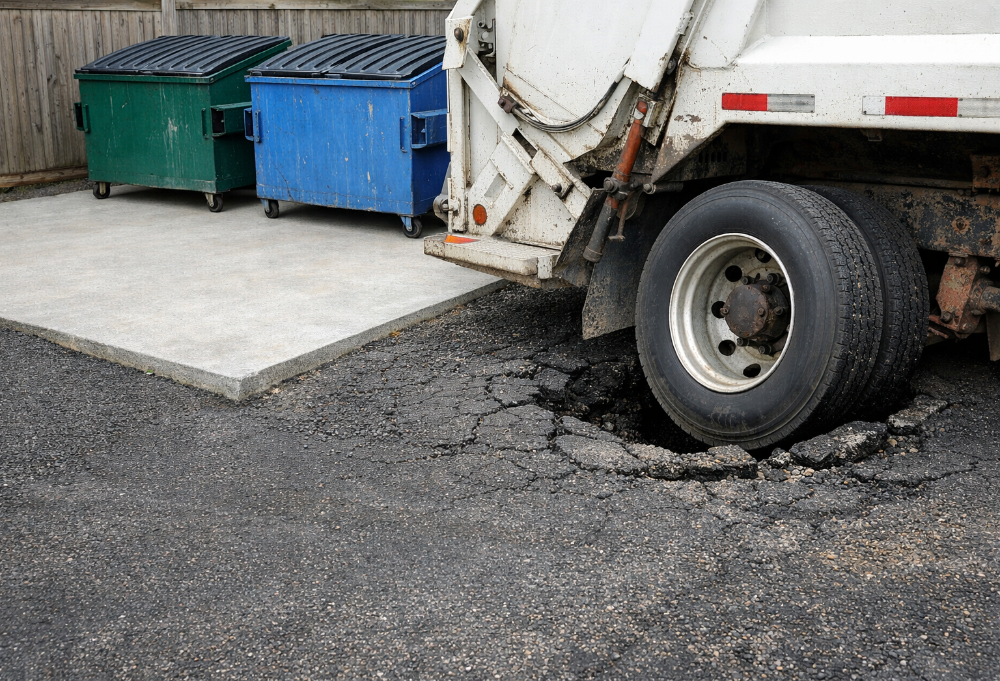
Properties throughout Lake County, IL face unique paving challenges because of changing soil conditions, groundwater, and seasonal freeze thaw cycles. Near the Lake Michigan shoreline, sinking asphalt is often more than a surface problem. It usually signals weakness beneath the pavement that requires proper stabilization before new asphalt can perform as intended.
Quick Answer
Fixing sinking asphalt near Lake Michigan shorelines typically requires rebuilding the weakened foundation, not simply adding more asphalt. Geotextile fabric helps separate unstable soils from new aggregate, while proper sub-grade stabilization creates a stronger base that resists future settlement, moisture intrusion, and pavement failure.
What Local Readers Should Know
-
Sinking asphalt is usually caused by unstable soil or water movement beneath the pavement rather than worn asphalt alone.
-
Shoreline communities throughout Lake County, IL often experience higher groundwater levels that can weaken pavement foundations.
-
Geotextile fabric creates a separation layer that improves load distribution and helps prevent aggregate from mixing with soft soils.
-
Freeze thaw cycles common along Lake Michigan can accelerate settlement if the pavement base was not properly constructed.
-
Early repairs typically cost less than allowing sinking pavement to expand into widespread structural damage.
Why This Matters Locally
Fixing sinking asphalt requires understanding the conditions unique to northeastern Illinois. Areas near Lake Michigan, including communities such as Waukegan, Zion, Winthrop Harbor, North Chicago, and Beach Park, often experience fluctuating groundwater, heavy seasonal precipitation, and clay-rich soils that can shift over time.
These conditions place additional stress on asphalt parking lots, private roads, commercial entrances, and residential driveways. Even inland portions of Lake County, IL can experience settlement where drainage is poor or soils become saturated after extended rainfall.
Real Paving understands that long-lasting pavement begins beneath the surface. Rather than covering visible depressions, we focus on correcting the structural issues causing pavement failure.
Local Field Observations
Professional field observations throughout Lake County, IL show that sinking pavement is frequently associated with poor drainage, saturated soils, and insufficient base preparation. Properties closer to Lake Michigan often experience elevated moisture levels that reduce the strength of the underlying sub-grade over time.
Commercial properties with frequent truck traffic may also experience accelerated settlement where pavement was originally designed for lighter vehicle loads.
Local Impact
Weak pavement foundations affect more than appearance.
For homeowners, sinking driveways can create drainage problems, standing water, and uneven walking surfaces.
For commercial properties, depressions can increase vehicle wear, create trip hazards, interfere with snow removal, and reduce curb appeal for customers. Parking lots serving retail centers, industrial facilities, and office buildings throughout Lake County, IL often experience these issues as pavement ages.
Warning Signs of Sub-Grade Failure
Watch for these indicators that the problem extends below the asphalt surface:
-
Depressions that continue growing over time.
-
Standing water after moderate rainfall.
-
Cracks radiating away from sunken areas.
-
Pavement that flexes under vehicle weight.
-
Edge failures near curbs or drainage areas.
-
Repaired sections that sink again after resurfacing.
-
Soft spots during warm weather.
-
Uneven transitions between pavement sections.
When to Call a Professional
Professional evaluation is recommended whenever pavement continues settling after previous repairs or when standing water repeatedly collects in the same location.
Minor surface cracks may be monitored temporarily, but widespread depressions, recurring settlement, or noticeable movement typically indicate foundation issues requiring excavation and stabilization. In shoreline areas, identifying the source of moisture is equally important to preventing future failures.
Common Local Causes of Sinking Asphalt
1. High Groundwater
Properties near Lake Michigan frequently experience elevated groundwater that weakens supporting soils beneath asphalt.
2. Poor Drainage
Water trapped beneath pavement gradually softens the base material and reduces its load-bearing capacity.
3. Clay Soil Movement
Much of northeastern Illinois contains clay soils that expand when wet and shrink during dry periods, contributing to uneven settlement.
4. Inadequate Base Construction
If aggregate was placed directly onto unstable soils without separation or sufficient compaction, the foundation may gradually lose strength.
5. Heavy Traffic
Delivery trucks, garbage trucks, and commercial traffic create concentrated loads that expose weaknesses within the pavement structure.
How Geotextile Fabric Improves Pavement Stability
Geotextile fabric acts as a structural separator between unstable native soil and the new aggregate base.
Instead of allowing crushed stone to sink into soft sub-grade, the fabric distributes vehicle loads across a wider area while maintaining separation between soil layers. This helps preserve the thickness and strength of the aggregate foundation over time.
Additional benefits include:
-
Improved load distribution.
-
Reduced long-term settlement.
-
Better drainage performance.
-
Increased pavement life.
-
Lower maintenance requirements.
For shoreline environments where moisture is a constant concern, geotextile stabilization often provides significant long-term value.
Prevention and Maintenance
Preventing future settlement begins with managing water before it reaches the pavement base.
Property owners can help by:
-
Keeping drainage structures clear.
-
Directing roof runoff away from pavement edges.
-
Addressing standing water quickly.
-
Monitoring small depressions before they expand.
-
Scheduling periodic pavement inspections, particularly after severe winters.
While routine maintenance can extend pavement life, structural settlement generally requires professional repair rather than surface patching.
Expected Results After Stabilization
Proper sub-grade stabilization addresses the underlying cause of sinking pavement rather than temporarily hiding it.
After excavation, stabilization, installation of geotextile fabric when appropriate, and proper compaction, property owners can typically expect:
-
Improved pavement support.
-
Better drainage performance.
-
Reduced future settlement.
-
Longer pavement service life.
-
Improved appearance and safety.
Actual performance depends on soil conditions, drainage improvements, traffic loads, and ongoing maintenance.
Common Mistakes
Mistake: Filling low spots with additional asphalt.
Consequence: The new asphalt often sinks as the unstable foundation continues settling.
Better Approach: Remove the failed section, stabilize the sub-grade, and rebuild the pavement structure correctly.
Mistake: Ignoring drainage problems.
Consequence: Water continues weakening the pavement foundation.
Better Approach: Correct drainage issues while rebuilding the affected pavement area.
Mistake: Choosing the least expensive surface repair.
Consequence: Repeated repairs frequently cost more than addressing the underlying structural issue.
Better Approach: Invest in foundation repairs that improve long-term performance.
Common Local Scenario
A commercial parking lot near the Lake Michigan shoreline develops several depressions where vehicles regularly enter the property. Surface patching temporarily restores appearance, but the same locations continue sinking within a year. Inspection reveals saturated soils beneath the pavement and insufficient base thickness. Excavating the failed areas, installing geotextile fabric, rebuilding the aggregate base, and repaving the surface provides a far more durable solution.
Related Service Solutions
Depending on site conditions, sinking asphalt may require:
-
Asphalt excavation and replacement.
-
Full-depth pavement reconstruction.
-
Geotextile fabric installation.
-
Aggregate base rebuilding.
-
Drainage improvements.
-
Parking lot rehabilitation.
-
Driveway reconstruction.
-
Commercial pavement stabilization.
Comparing Your Options
| Option | Best For | Limitations |
|---|---|---|
| Surface patching | Minor isolated defects | Does not repair unstable sub-grade |
| Asphalt overlay | Structurally sound pavement | Existing settlement often returns |
| Full-depth repair | Localized foundation failure | Requires excavation |
| Sub-grade stabilization with geotextile fabric | Weak or saturated soils | Higher initial investment but stronger long-term performance |
Service Areas
We proudly serve property owners throughout Lake County, IL, including Waukegan, Zion, Beach Park, Gurnee, Libertyville, Vernon Hills, North Chicago, Winthrop Harbor, Highland Park, and surrounding communities. We also work with residential, commercial, and municipal clients throughout northeastern Illinois.
Cost of Ignoring the Issue
Waiting rarely improves sinking pavement.
As settlement progresses, cracks widen, drainage worsens, and additional pavement sections become affected. Small structural repairs can eventually become complete pavement reconstruction projects, increasing repair costs and disrupting property use.
Frequently Asked Questions
Does sinking asphalt always require complete replacement in Lake County, IL?
Not always. If settlement is localized, only the affected sections may require excavation and sub-grade stabilization. The appropriate repair depends on the condition of the surrounding pavement and the underlying soil.
Why is geotextile fabric useful near Lake Michigan?
Geotextile fabric helps separate aggregate from weaker native soils while improving load distribution. This can be especially beneficial in areas with elevated groundwater and moisture-sensitive soils commonly found near the shoreline.
Can drainage problems cause asphalt to sink?
Yes. Water weakens the supporting soils beneath pavement over time. Correcting drainage is often an essential part of preventing future settlement.
How can I tell if my driveway has foundation problems?
Recurring low spots, standing water, expanding cracks, and pavement movement under vehicle loads often indicate issues beneath the asphalt rather than simple surface wear.
Is freeze thaw weather in Lake County, IL hard on asphalt?
Yes. Seasonal freezing and thawing can accelerate movement in moisture-sensitive soils, increasing the likelihood of cracking and settlement where the pavement foundation is already weak.
Is resurfacing enough for sinking parking lots?
Usually not. Resurfacing improves appearance but does not correct unstable soils or inadequate base construction. Structural repairs may be necessary before new asphalt is installed.
How long does sub-grade stabilization take?
Project timelines vary based on excavation depth, weather, drainage improvements, and the size of the affected pavement area. A professional evaluation provides the most accurate schedule.
Is geotextile fabric used on both residential and commercial projects?
Yes. Geotextile fabric can benefit residential driveways, commercial parking lots, private roads, and other paved surfaces where unstable soils require additional structural support.
Protect Your Pavement from the Ground Up
Strong pavement starts with a stable foundation. By identifying the true cause of sinking asphalt and using proven stabilization methods, property owners throughout Lake County, IL can improve pavement performance and reduce future repair costs.
Schedule Your Local Pavement Evaluation
Whether you are dealing with a sinking driveway, parking lot, or access road near the Lake Michigan shoreline, we can help evaluate the underlying conditions and recommend the right long-term solution.